

Redefining permanence across the magnet ecosystem
Strengthening domestic supply through proven, scalable technology
Understanding the most valuable rare-earth element
The rare-earth group consists of chemically similar 17 elements, which are used in a wide variety of industrial applications, from catalysis to lighting. However, the most valuable use of rare earth elements is in permanent magnets. There are two main compositions of rare-earth magnet, which are based upon neodymium iron boron (NdFeB) or samarium cobalt (Sm:Co).
Rare-earth magnets play a fundamental role in energy generation and utilisation, which is becoming increasingly important as we move towards an electricity-driven society. They are essential across industries from aerospace, robotics, electronics, wind turbines, medical and automotive. There are hundreds of magnets deployed in electric and hybrid cars within key applications such as drive motors, fans, generators, power steering, pumps, seat motors and loudspeakers.





Decoding the supply challenge
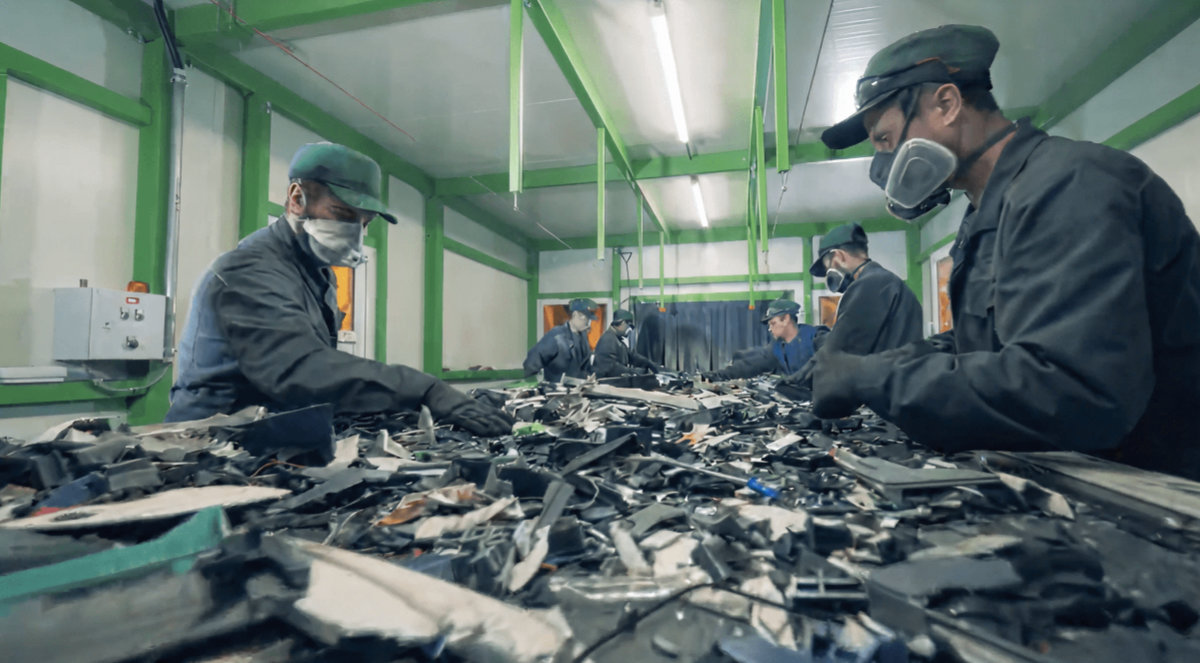
At present, very little rare-earth material is recycled due to technological difficulties in separating magnets from waste streams. For example, removing an NdFeB magnet contained within a computer hard disk drive requires the removal of 8-10 security screws, while the magnet stays glued in place and coated in Nickel.
While a great majority of electronic and automotive waste streams are shredded today, on shredding, the contained NdFeB magnets break up into a friable magnetised NdFeB powder. which then sticks to the ferrous scrap and the shredder itself.
Our solution: a short-loop recovery process
HyProMag USA addresses this challenge through Hydrogen Processing of Magnet Scrap (HPMS), a patented, energy-efficient technology. During HPMS:
Products are exposed to hydrogen at atmospheric pressure and room temperature
Crucially, the powder is demagnetised, enabling easy extraction


The NdFeB magnets absorb hydrogen and break apart into powder
The Nickel coating peels away and can be separated using mechanical means
The result: production-ready feedstock
The resulting NdFeB powder is of sufficient purity to be directly reprocessed into new magnetic materials or rare earth alloys, converting embedded magnet material into production-ready feedstock for a wide range of applications.
Why this works
HyProMag USA’s model is structurally stronger because it simplifies production, reduces risk, and accelerates deployment in a market where demand is permanent, and supply certainty is critical.

Modular, scalable & flexible
Production units can be deployed and replicated across the United States, producing multiple magnet grades simultaneously without reliance on single, capital-intensive facilities.

Short and streamlined process
Traditional magnet production can involve up to 24 steps. HyProMag reduces this to 5 focused stages, lowering complexity while moving closer to finished magnet production.

Faster to market with strong economic
By focusing on recycling existing magnet material, HyProMag USA bypasses the 10–15 year timelines associated with mining and long-route processing, enabling faster deployment and efficient throughput.

Strategic fit for U.S. industry
The model integrates directly into U.S. manufacturing ecosystems, taking scrap from industrial partners and returning finished magnet material into domestic supply chains.
